
My last set of scans in late June wasn’t great. In fact, it was less than great.
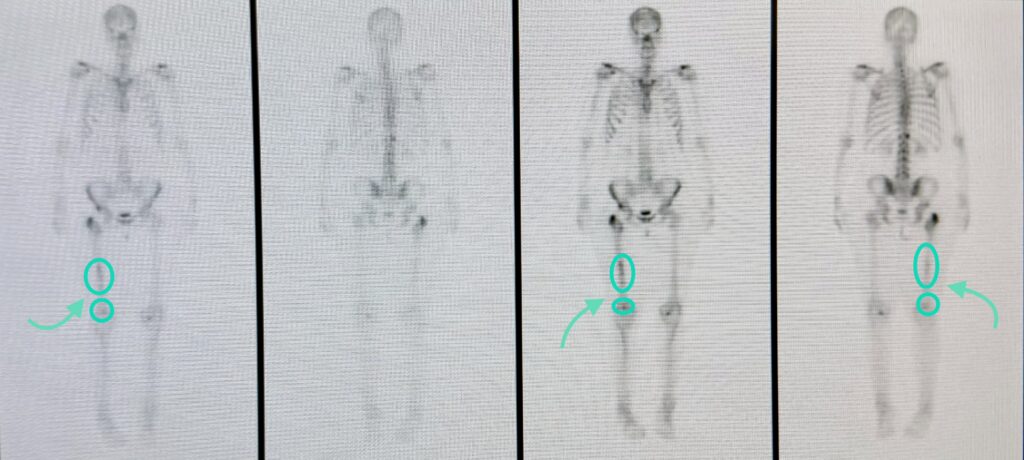
I have multiple progressions in my right leg. In the space of nine weeks, a 9 cm lesion grew around the lower part of the artificial portion of my femur, extending past the end of the rod. There’s another one–1.5 cm–slightly above the patellar surface.
Nine weeks. Nine centimetres. I’d like to say I stopped noticing the pattern in numbers like that a long time ago.
I haven’t.
I got this news an hour and a half before my kids came back from their dad’s. Two days before school let out for the summer.
I slumped to the ground, landing on the bottom stair leading up to the second floor, tears streaming down my face. Think ugly crying–big, wailing sobs–trying to say something, anything coherent to my partner in between gasps for air and self-pity. He sat beside me, arm around my shoulders, listening, supporting me, helping me get it all out before I had to put my “everything is OK” mum face on.
There is no version of this where the timing is good. But there’s a particular cruelty to hearing it in that window–the shrinking hour before the people you love most walk through the door and you have to decide how much of yourself they get to see.
The front door opened. My kids came in. Game face on.
For now.
The following day came the conversation with my oncologist, and some options that were very hard to hear.
A change in my line of treatment–I’ve only been on this one five months. Radiation–but I’ve already had radiation to my leg twice; there might be an opportunity for a third round. Surgery–perhaps we take the entire femur out. And then the most aggressive, most chilling option of all: amputation above the 9 cm lesion.
My medical oncologist put the wheels in motion. My full oncology team was being brought in: my two radiation oncologists and my orthopaedic surgical oncologist. Additional scans were ordered to get a better look at the 9 cm lesion and to confirm whether it was “real.” The 1.5 cm one was definitely a metastasis.
Then I waited.
It took six weeks to get in to see my own radiation oncologist. The queue for scans had grown significantly. I hadn’t been called for either the CT of my leg or the high-definition x-ray. My radiation oncologist double-checked the system–the requisitions were there. But the newly introduced pay-for-diagnostic-imaging model in Alberta, combined with a limited workforce, meant I was still in the queue. One scan was booked for mid-October, when I needed it before the end of August. For the other, I was still waiting for a call.
In 7.5 years of living with terminal cancer, I have never had an appointment where I couldn’t get my regular scan to monitor my progression. This scan could mean life–or earlier death–for me. And I was in limbo.
It also meant making a treatment decision without all the information. I had already waited six weeks. A decision needed to be made.
We talked through the four initial options and narrowed it down to two: radiation or femur replacement.
Then came the questions.
On radiation:
- Do we irradiate the whole leg, or treat each lesion–the 9 cm and the 1.5 cm–separately?
- The small lesion could be treated with SBRT. In plain terms, SBRT (stereotactic body radiation therapy) delivers very precise, very high doses of radiation to a small, well-defined target–think sniper shot, not floodlight. It hits hard, spares surrounding healthy tissue, and typically takes far fewer sessions.
- The 9 cm lesion can’t be done with SBRT. It’s too big. SBRT works best on small, contained targets; at 9 cm, there’s no way to treat it that precisely without risking the bone and surrounding structures.
- If we treat the two lesions separately, does the bone between them get protected? Given the distance–and once you factor in the radiation margin around each target–likely not. You end up irradiating most of the space between them anyway.
- If we radiate both lesions using standard protocols, will we get it all? Likely not.
- If we treat them separately? The 1.5 cm–maybe. The 9 cm–probably not.
On surgery:
- Do I feel pain at the lesion sites? No.
- Am I physically fit for this surgery? Yes.
- Recovery time? Easily a year. Maybe longer.
- Will we get all the cancer? Most likely–but I’d still need palliative radiation afterward to mop up any straggling cells.
I know my team had already talked through all of this amongst themselves. Now the decision was essentially mine–though my radiation oncologist wanted to confirm first whether my orthopaedic surgeon, now that we’d had a full discussion and my physical was done, still believed the surgery’s benefits outweighed those of radiation.
We move forward with the expectation that I’ll proceed with radiation–from above the 9 cm lesion down into the knee. I still need the scans, but we can no longer wait.
So we proceed with the intent to irradiate. He finds a workaround for one scan and expedites my radiation planning.
We get the planning back within three business days. Three–with the September long weekend in between. Unheard of.
And in the meantime, the scan he worked around? Not good. The cancer has progressed further into the hip.
Terrifying.
The Decision (I Wish I Didn’t Have to Make)
I start radiation today. Which means I finally have time to answer a question people have asked me before:
How do you make a decision this difficult when none of the options are remotely palatable?
The answer is: it depends.
- Where you are in your life–your age, your relationships, your goals.
- What matters most to you–quality of life, mobility, activity, longevity, and the quality of the time you have.
The one thing I’m certain is the same for everyone: it’s done with much difficulty.
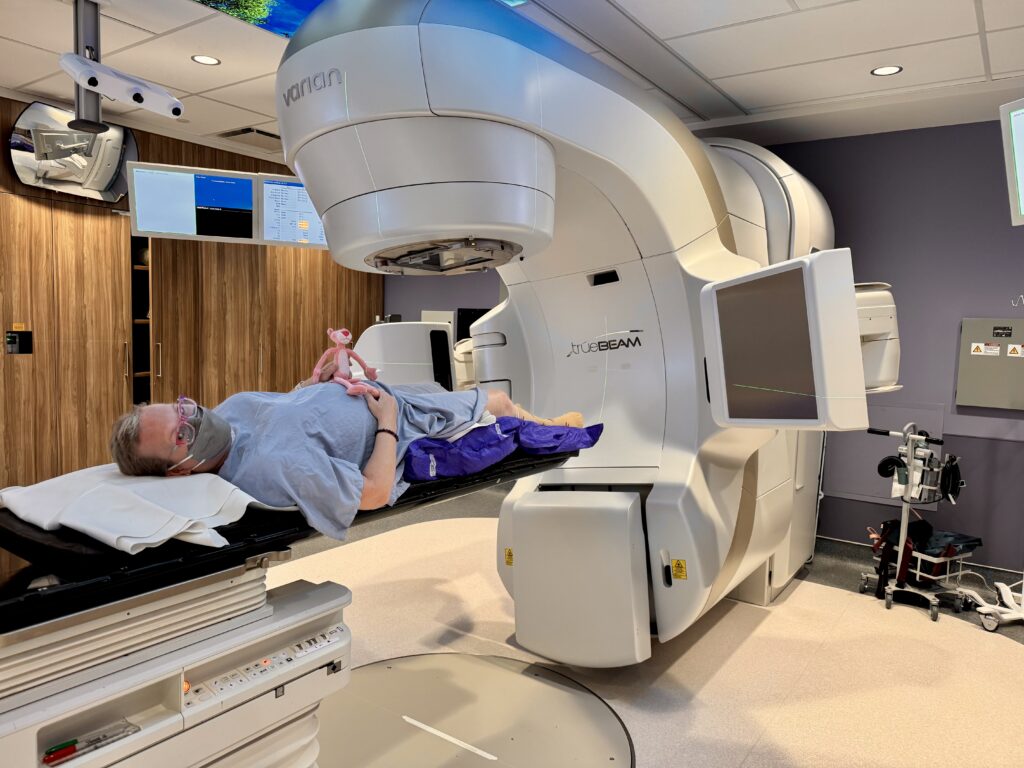
This is as hot of the presses that it can get: I now have to leave for my first radiation session. This is me getting my radiation treatment a few minutes ago.
If this post moved you, or if my writing has meant something to you along the way–a small gift goes a long way in helping me keep this space going. No pressure, ever. But if you’d like to: Buy me a coffee →